

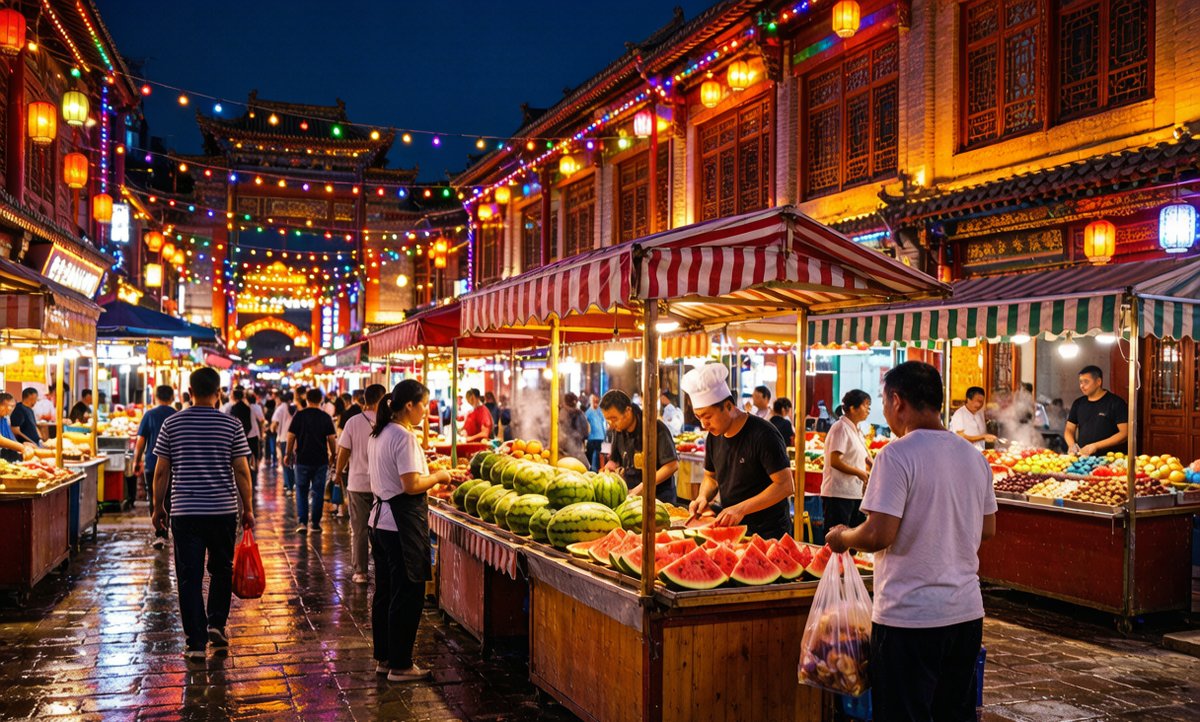
Eating at a Uyghur uncle’s house for the first time, I learned ‘grab polo with your right hand’ isn’t a show — it’s habit, and the table manners stuck with me longer than the food.
Uyghur food is the lead role on Xinjiang’s table, deeply shaped by the Silk Road and Central Asia. Nang, polo, kebab and thin-skin buns form the everyday; festivals bring the whole lamb and big platters. Here’s what it is, how to eat it and the etiquette — because in a Uyghur home the manners are half the meal.
Nang: the staple that lasts a week
Baked in a tandoor, nang comes in dozens of types — sesame, oil, onion. One is 3–8 RMB, dry and durable, the perfect road dry-rations. Torn into milk tea it’s a classic breakfast. I keep ten in the car on the Duku; hungry? Tear a piece and you’re set. The tandoor is a dome oven fired with apricot wood, and the bake seals the crust so the inside stays soft for days. Every oasis town has a nang bakery firing at dawn; the smell is the alarm clock. Walnut nang in Hotan is a sweet-salty snack, raisin nang is dessert. I’ve broken nang with truck drivers at a pass checkpoint and watched the ice break faster than any small talk. It’s the cheapest, most useful food item in Xinjiang — and the most cultural.
- Dozens of types; 3–8 RMB each
- Baked in apricot-wood tandoor at dawn
- Keeps a week — the road staple
The craft of polo
Yellow carrot (not orange), lamb fat, cumin and rice braised together. After Friday prayers families cook a big communal pot — ‘Friday polo’. Good polo has glossy, separate grains and sweet-tender yellow carrot. Invited to a home, the host ladles a big bowl into your hand — the highest courtesy. The craft is in the carrot: Xinjiang yellow carrot is sweeter and mealier, and it melts into the rice so the whole plate tastes of lamb and sun. A tourist polo is often orange-carrot and bland; a home polo is the real thing. I was once handed a steaming bowl straight from the pot at a Kashgar home and told to eat with my right hand — awkward at first, then natural. The fat is meant to be there; it’s the flavour, not a flaw.
- Yellow carrot + lamb fat + cumin
- Friday communal pot = ‘Friday polo’
- Eaten by hand from the host’s bowl
Hosting and etiquette
Wash hands first (ewer rinse), take food with the right hand, don’t leave rice — these basics make you ‘one of us’ more than any dish. When the host refills tea it’s politeness; cover the bowl with your hand when done. The ewer rinse before eating is a ritual of cleanliness, not ceremony — you’ll see it at every home and many restaurants. Taking food with the right hand only is the core rule; the left is reserved. Leaving rice in the bowl reads as ‘not enough’ or ‘wasteful’ — eat what’s served, or take little and ask for more. I fumbled the tea-refusal once and got a second pour; covering the bowl with your palm is the universal ‘I’m full’. These small acts open doors a menu never will.
- Ewer hand-wash before eating
- Right hand only for food
- Cover bowl with palm to refuse more tea
Where it’s most authentic
Old-city and family eateries in Kashgar and Hotan are the real deal; scenic-area restaurants are toned down for tourists. I spent 5 RMB on brick tea in a Kashgar old-town tea house, listening to a dutar next to me — worth more than any restaurant. The old town’s value isn’t just price; it’s the continuity — the same recipe from the same family for generations. Hotan’s night market is the south’s best kept secret for polo and kebab. Scenic-area spots soften the spice and raise the price for visitors; the lanes keep it honest. I treat a crowded local shop as a guarantee and an empty scenic restaurant as a warning. Eat where the grandmother is cooking, not where the tour bus stops.
- Kashgar + Hotan old-city kitchens
- 5-RMB brick-tea houses beat restaurants
- Crowded local shop = guarantee
Sweets and festivals
At Corban every home slaughters a sheep, cooks polo and lays out candy; at Nowruz there’s Nowruz rice (mixed grains and herbs). Everyday sweets are fruit and clotted cream. Visiting at a festival, don’t arrive empty-handed — sugar or tea is the right tact. The festivals are when Uyghur cooking goes big: a whole lamb on a platter, mountains of polo, trays of nuts and dried fruit. Nowruz (Persian new year, March) brings the herb rice that signals spring. I timed one trip to Corban and ate at a neighbour’s table uninvited — the door was open and the food was out. If you’re in the region for a festival, the old town is where to be; just bring something sweet and accept the bowl offered to you.
- Corban: whole lamb + polo + candy
- Nowruz: herb-mixed rice for spring
- Bring sugar/tea if visiting a home
Reading a Uyghur menu
Menus are often Uyghur script with a few Chinese characters; the translation app handles the script, but the safe move is to point at what the next table is eating. Polo, laghman, samsa, kebab and the thin-skin bun (piewon) are on nearly every menu and are always safe bets. ‘Piewon’ — a steamed bun with soup inside — is the breakfast hero; bite the top, sip, then eat. Don’t over-order; portions are generous and sharing is the norm. I order two dishes for two people, not one each, and we eat from the centre. If unsure, ‘what’s good today?’ with a gesture at a full table gets you the right answer. The menu is a guide, the room is the truth.
- Piewon (soup bun) = breakfast hero
- Point at the next table’s dish
- Order 2 dishes for 2, share from centre
| Food | Trait | Price |
|---|---|---|
| Nang | Durable, dry-rations | 3–8 RMB |
| Polo | Yellow-carrot braise | 15–25 RMB |
| Thin-skin bun | Thin wrap, juicy | 3 RMB each |
| Milk tea | Salty, fragrant | 5 RMB |
Practical takeaways
- Wash hands first — it’s etiquette.
- Leaving rice is impolite; order little, add often.
- Old tea houses beat restaurants for value.
- Bring something sweet if visiting a home.
Frequently Asked Questions
- Why yellow carrot in polo?
- Xinjiang yellow carrot is sweeter and mealier — the soul of polo, distinct from orange.
- Eat polo with hands?
- Traditionally yes; restaurants give a spoon — your call, right hand is the etiquette.
- Where’s the most authentic?
- Kashgar and Hotan old-city family kitchens, not scenic areas.
- How do I read the menu?
- Point at the next table’s dish; polo, laghman, samsa, kebab, piewon are always safe.