

The far north of Xinjiang is a different country — birch forests instead of deserts, wooden villages instead of adobe, and a chill in the air that says “Siberia is not far.” The Altai and Kanas region, up by the Mongolian and Russian borders, is the most alpine, most forested, most “could-be-Switzerland-if-Switzerland-had-yurts” corner of the province. Driving it is a reward for travelers who’ve done the headline routes and want the quiet north. Here’s the overland briefing.
The route north
- Urumqi → Karamay → Burqin → Kanas/Hemu, roughly 700–800 km over two days (it’s a long haul; break at Karamay or Burqin).
- From Kanas you can loop east via the grand loop back toward Urumqi, or fly out of nearby Altay/Beitun.
- The roads are paved but climb steadily into the Altai; an SUV’s comfort helps on the final mountain stretches.
Burqin: the colorful gateway
Burqin is the last real town before Kanas — famous for its colorful, folk-art architecture and its riverside night market (the grilled fish from the Irtysh River is a local legend). Use it to fuel, eat, and sleep before the early push into the park. It’s also where you buy park entry and shuttle tickets for Kanas.
Kanas Lake: the teal heart
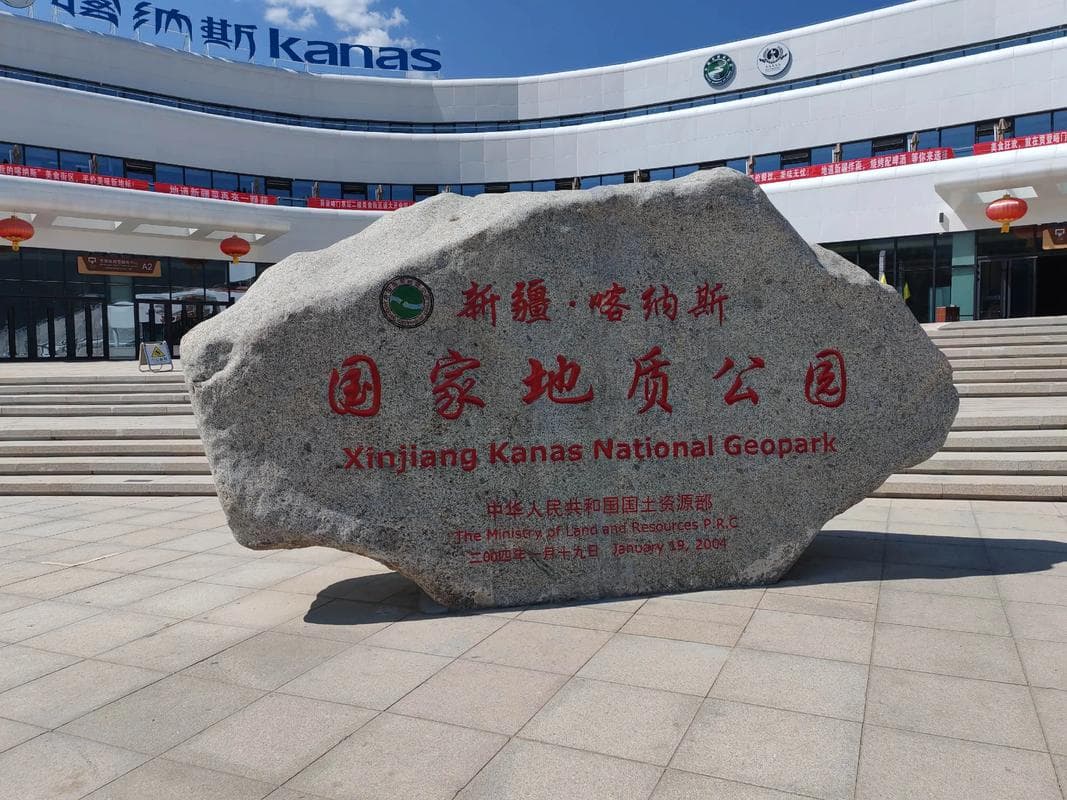
Kanas Lake is the prize — a glacial lake of impossible teal locked in fir-covered mountains, with folklore of a “lake monster” (probably giant sturgeon) and boardwalks that let you wander the shore. Highlights:
- The viewing platform above the lake — the iconic panorama.
- A boat ride across to the quieter bays.
- The river mouth and the “three bays” (Moon, Fairy, Wolong) walk.
- The folklore — ask a local about the monster; the stories are half the fun.
Hemu: the wooden village
A short drive (or shuttle) from Kanas, Hemu is a village of weathered timber cabins among birch forest, home to the Tuva people. It’s the most photographed spot in the north — and deservedly: dawn light on the cabins and the morning mist is unreal. Stay a night; the early risers get the magic. Our camping guide covers the sites around here.
The Altai beyond
If you have time and the right season, the Altai offers:
– Keketuohai (Koktokay) geopark to the east — canyon and gem-mining country (our guide).
– Hemu’s higher trails for multi-day treks in summer.
– Autumn color — late September, when the birches go gold, is the peak of the peak.
When to drive it
- June–September is the window; the park closes or limits access in deep winter (though the snow scene is spectacular for the prepared — see winter driving).
- Late September is the photographic pinnacle — gold birches, blue lake, thin crowds.
- The best-time guide has the detail.
Practical notes
- Park shuttles: private cars are restricted inside Kanas/Hemu core areas; you park at the gate and use the shuttle. Plan your days around the shuttle schedule.
- Permits: standard entry; no special border permit for Kanas itself, but carry ID (the region is sensitive).
- Altitude: modest (1,300–2,000 m) — easy on lungs.
- Book accommodation ahead in July–August and the National Day week; the north is popular.
Food and stay
Burqin’s riverside market, Kanas guesthouses serving simple northern fare, and Hemu’s cabin stays. It’s hearty, meat-and-noodle country — the food guide has the broader map.
FAQ
How many days for Kanas + Hemu? Two nights minimum (one each), three to relax.
Can I drive inside the park? No — park at the gate, use shuttles. Your car stays outside.
Is it worth the long drive from Urumqi? For the alpine scenery, yes — it’s the most “north” Xinjiang gets.
Best season? Late September for color; July–August for green and access.
Final word
The Altai and Kanas are Xinjiang’s quiet north — forests, timber villages, and a lake that doesn’t look real. It’s a longer haul to reach, and that’s exactly why it stays special. Drive up, slow down, and let the birches do the talking.
Written by Karl Huang, a Xinjiang-based travel writer. Park access and shuttle rules change by season — confirm with the scenic area before you go.