

When I first drove Xinjiang in an electric vehicle in 2023, the experience hovered somewhere between adventure and calculation. Every leg began with a question: “Will we make it to the next charger?” Three years later, the answer is far more comfortable. A xinjiang ev road trip is no longer an experiment for early adopters, but it still requires route planning that fuel drivers can ignore. This guide covers the 2026 charging network, realistic range, and the routes where EVs make the most sense.
 }
}
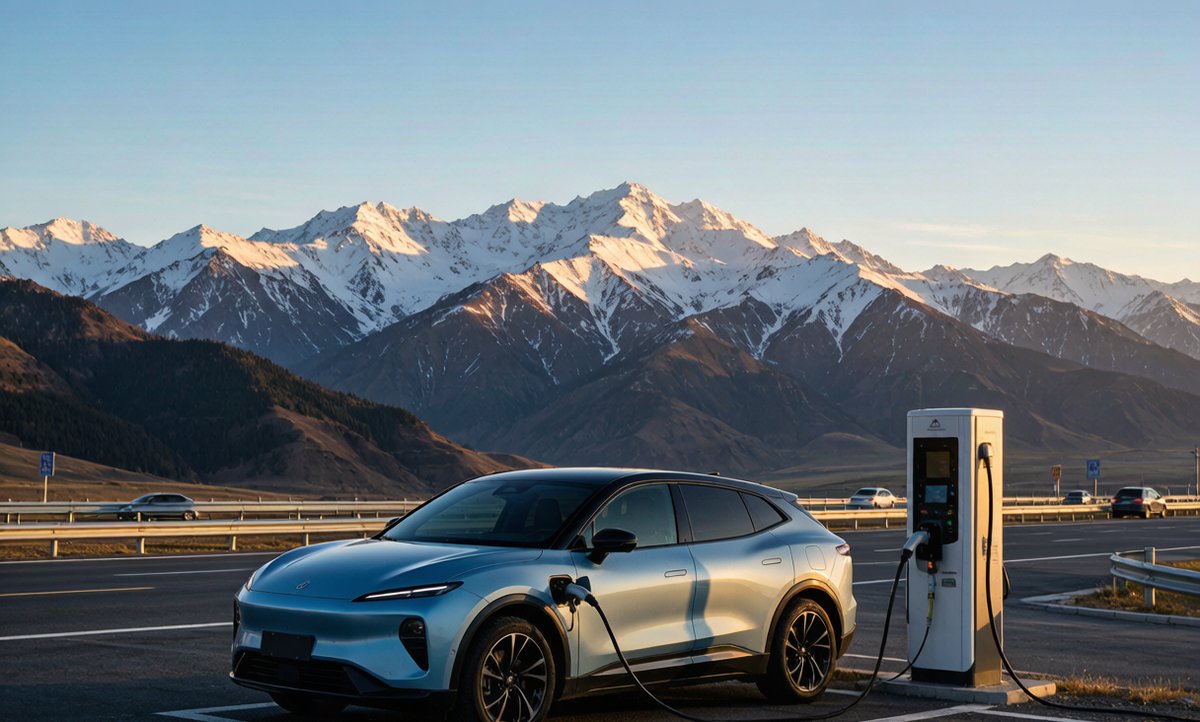
The charging picture in 2026
Xinjiang’s charging network has expanded fastest along the G30 Lianhuo Expressway, the G7 Beijing–Urumqi corridor, and the ring around Urumqi. State Grid, TELD, and a handful of private operators now cover most prefecture-level cities and major highway service areas. If you stick to a Urumqi–Turpan–Korla–Kuqa route or the northern loop through Shihezi, Yining, and Jinghe, you can usually find a 120 kW DC fast charger every 150–250 km.
The gaps remain in the south and west. The Taklamakan Desert crossings, the Pamir Highway beyond Kashgar, and parts of the Altai are still thin. On the Duku Highway self-drive guide route, chargers exist at both ends and at Bayinbuluke, but the middle 200 km are sparse. Plan your longest daily leg to end where a charger is guaranteed.
What range actually looks like
Manufacturers’ WLTP range figures are a polite fiction in Xinjiang. The real world cuts them down in three ways:
- Altitude: Climbing from Urumqi (800 m) to the Hashiligen Pass (3,400 m) on the Duku increases consumption by 30–40% on the uphill section.
- Speed: Xinjiang expressways allow 120 km/h. Sustained high-speed driving can raise consumption 20–25% over city cycles.
- Cold: Early autumn mornings at Kanas or Hemu can drop below freezing. Winter road trips are even harsher; expect range to fall 30–50% on the coldest days.
My practical rule is to assume 60–70% of the manufacturer’s stated range when planning between chargers. If your EV claims 500 km, plan for 300 km of comfortable range and leave a 50 km buffer.
Best EV routes in Xinjiang
Some routes are already excellent for EVs; others still punish poor planning.
- Urumqi–Turpan–Korla–Kuqa — This eastern arc has the densest charging network. Daily drives of 200–300 km work well, and the cities have multiple charging plazas.
- Urumqi–Shihezi–Yining–Nalati — Good coverage in the Ili Valley. The Nalati grassland area has chargers in nearby Xinyuan.
- Urumqi–Duku Highway–Kuqa — Doable but not relaxing. Top up at Dushanzi and Kuqa; treat the Duku as a single-day hop with no charging in between.
- Kashgar–Tashkurgan — Only for confident EV planners. Chargers exist in Kashgar and Tashkurgan, but the 300 km stretch is demanding. Read our Xinjiang road trip safety notes before attempting this.
Charging apps and payment
Most chargers in China use state-owned networks. The apps you will need are:
- e充电 (eCharging / State Grid) — covers the widest highway network.
- 特来电 (TELD) — strong in cities and service areas.
- 星星充电 (StarCharge) — useful in Urumqi and Korla.
Foreign cards rarely work directly. The easiest way is to ask your rental-car company or hotel front desk to help set up a mini-program in WeChat or Alipay. Many chargers also accept simple prepaid cards, which can be bought at larger service-area stores with cash.
Cost comparison
Electricity at highway fast chargers in Xinjiang typically runs 1.2–1.8 RMB per kWh, plus any parking or service fees. On a 1,500 km loop, an EV using roughly 300 kWh will spend 400–550 RMB on charging. A comparable fuel car at 8 L/100 km with 95-octane petrol around 8.5 RMB/L would spend roughly 1,000 RMB. The EV saves money, but the time cost is higher: each fast charge adds 40–60 minutes. Our full Xinjiang road trip budget breakdown puts the charging savings at roughly 40–50% on fuel, assuming you can use a mix of fast charging and overnight slow charging.
Practical EV tips for Xinjiang
- Start each day at 90% if the hotel or guesthouse has a slow AC charger. Slow charging overnight is cheaper and gentler on the battery.
- Carry a Type 2 cable and a portable 16A charging gun. Rural hotels may only have a standard 220 V socket.
- Check PlugShare and Amap before you commit to a remote route. App listings are not always accurate; a charger listed as 120 kW may only deliver 60 kW.
- Avoid midday heat in Turpan. Battery cooling systems work harder above 35 °C, and charging speeds drop.
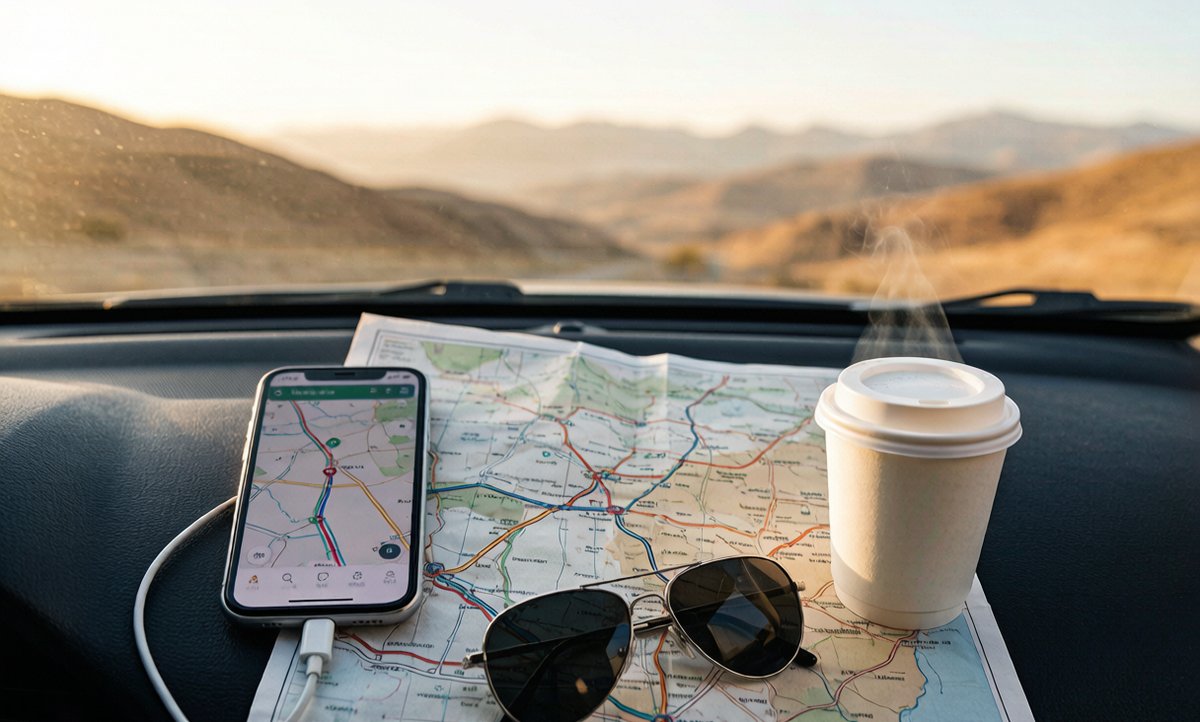
- Plan for offline maps. Coverage is good on highways but patchy in the mountains.
Charging etiquette and backup plans
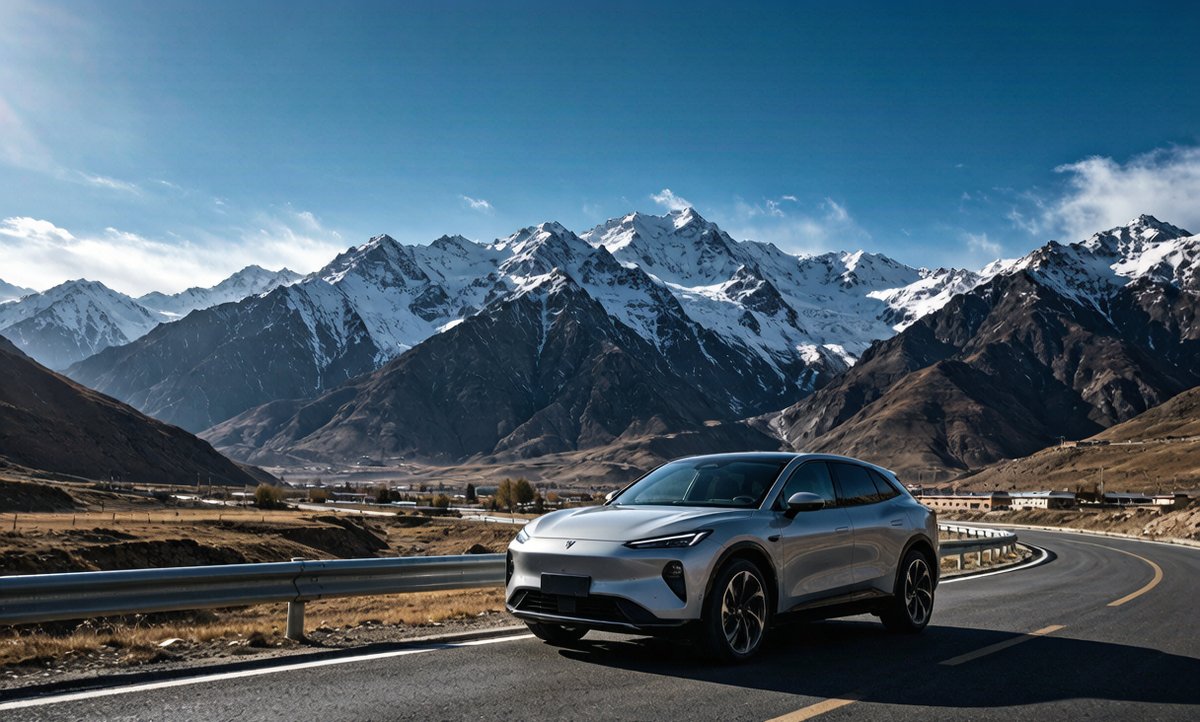
When a charger is occupied, queue politely and do not unplug someone else’s car unless they have clearly finished. At rural stations, carry enough cash or a charged payment app, because the QR code scanner sometimes fails in bright sunlight. I also photograph the charging station location on Amap before leaving the car, so I can find it again in the dark or snow. These small habits remove the low-level anxiety that can make an EV trip feel harder than it is.
Is an EV right for your Xinjiang trip?
If your route stays on the main north–south and east–west corridors, an EV is now genuinely practical. If you plan to cross the Taklamakan, drive the western Pamir, or explore the Altai backroads, a fuel or hybrid vehicle is still the safer choice. For most first-time visitors, the best compromise is a plug-in hybrid or a fuel car with good fuel economy.
FAQ
Can I rent an EV in Urumqi? Yes. Most major rental agencies at Urumqi Diwopu International Airport now offer EVs, though the selection is smaller than in Beijing or Shanghai.
What connector types are used? Most public DC chargers use the Chinese GB/T standard. Some new highway stations also offer CCS2 adapters, but do not rely on them.
How long does a fast charge take? From 20% to 80% on a 120 kW charger typically takes 35–50 minutes for a modern EV with a 60–80 kWh battery.
Are there charging stations at Kanas or Hemu? No reliable public DC chargers inside the scenic areas. Charge fully in Burqin before entering.
Does cold weather really hurt range that much? Yes. At freezing temperatures, expect 20–30% range loss; below -10 °C, losses can reach 40%.
Final word
An EV road trip through Xinjiang is no longer a novelty, but it still rewards the planner. Stick to the main corridors, charge whenever you can, and keep a buffer for the mountains. Done right, the silence of an electric drive through the Tianshan is worth the extra stops.
Written by Karl Huang, a Xinjiang-based travel writer. Charging network coverage and pricing change quickly — confirm current charger locations with your rental company or charging app before you set out.