

The first time I drove from Kashgar toward Tashkurgan, I was pulled over at a checkpoint about 60 km out of the city. The officer was polite. He simply pointed at my passport and said, “Border area. Where is your 边防证?” I had one. But the couple in the car behind me did not, and they were turned back toward Kashgar. That ten-minute stop taught me more about the Xinjiang border pass than any forum post ever had.
If your Xinjiang road trip stays in the main cities and the northern grasslands, you will almost never need a border permit. But the moment you point your wheels at the Pamir Plateau, the Karakoram Highway, or certain corners of the Altai, the 边防证 (biānfángzhèng, literally “border defense certificate”) becomes the single document standing between you and some of the most spectacular driving in Asia. This guide walks through exactly when you need it, where to get it, and what to carry.
What the 边防证 actually is
The border pass is a simple paper permit issued by the public security bureau (PSB) that lets you enter designated border-defense zones. It is not a visa. It is not tied to the international border crossing itself (passing into Pakistan at Khunjerab is a separate matter entirely). It simply authorizes you to be in the sensitive belt of land that runs along China’s frontiers.
For self-drivers, the permit matters because the checkpoints are real and frequent. On the road from Kashgar to Tashkurgan, for example, you will pass several document checks. Without the permit, you will not get past the first one near Opal (Oupu) township, roughly 50–70 km from Kashgar.
Which regions require it
Here are the areas most relevant to road-trippers:
- Tashkurgan Tajik Autonomous County (the Pamir Plateau) — this is the big one. The entire county, including Karakul Lake, the Karakoram Highway, and the road toward Khunjerab, sits in a border zone.
- Khunjerab Pass — the permit is required to drive the final stretch toward the Pakistan border, even if you only go as far as the border marker and turn back.
- Parts of the Altai region — some frontier areas near the Kazakhstan and Mongolia borders in northern Xinjiang have required permits at times. Check locally; the rules here shift more than in the south.
- Certain Taklamakan edge towns — generally not required, but a couple of frontier settlements have had temporary controls.
If your plan is the classic Kashgar to Pamir Karakul drive, assume you need the permit.
Where to apply
You have three realistic options, and I have used two of them myself.
1. In Kashgar (easiest for travelers already in the region)
The entry point most travelers use is the PSB office in Kashgar. In recent years the process has been streamlined, and many mid-range and higher hotels in Kashgar can also help arrange the permit for guests, or at least point you to the right window. You typically apply in the morning and can collect the same or next day. Bring your passport (foreign travelers) or your Chinese ID card (mainland residents).
A practical tip: apply the day you arrive in Kashgar, not the morning you want to leave. Processing can take a day, and you do not want to burn a precious Pamir morning waiting in an office.
2. In your home city in China (best for Chinese residents)
If you are a Chinese resident, you can often obtain the 边防证 at the PSB entry-exit office in your home city before you even fly to Xinjiang. The advantage is that you arrive ready to drive. The disadvantage is that home-city offices sometimes limit the listed destinations, so confirm they will write “Tashkurgan” or “Kashgar Prefecture border areas” on the form.
3. At the border Public Security station near the checkpoint
Some travelers report being able to get a temporary permit at stations near the Opal checkpoint, but I would not rely on this. It is slower, less certain, and wastes your driving day. Get it in advance.

What you need to bring
The document list is short:
- Passport (for foreign travelers) with a valid Chinese visa or visa-free status, plus a few photocopies.
- Chinese ID card (for mainland residents) — and a copy.
- A simple application form filled at the office, listing your destination counties and travel dates.
- Hotel details — the name and address of where you are staying in Kashgar. Some offices ask.
- A local contact or driver’s details if you are in a rented car with a driver.
There is usually no fee for the border pass itself. The “cost” is your time and the planning discipline to apply early.
Validity and the fine print
The permit is typically valid for a limited window — often 7 to 30 days depending on what the office writes — and names the specific border counties you may enter. It is not a blanket pass for the whole frontier. If you list only Tashkurgan, do not expect to detour into a different border county without a new application.
A few realities worth internalizing:
- The permit covers being in the zone. It does not let you cross an international border. For the Khunjerab Pass drive to Pakistan you need a Pakistan visa, vehicle paperwork, and usually a guided arrangement.
- Checkpoints scan the permit. Keep the original in the car, not in a hotel safe.
- Rules change. The destinations that require a permit, the offices that issue it, and the validity period have all shifted from year to year. Treat anything in this article as a planning baseline, not a guarantee.
Foreign travelers vs. Chinese residents
This is the part people get wrong. Chinese citizens apply with their ID card and the process is well established. Foreign passport holders can and do get the permit, but the list of issuers that will process a foreigner can be narrower, and some frontier areas have at times been restricted to foreign visitors regardless of permit. If you hold a foreign passport, confirm two things before you build your itinerary: that the specific county (usually Tashkurgan) is currently open to foreign travelers, and that the Kashgar office will issue to a passport holder. Your embassy travel advisories and a call to your Kashgar hotel are good first checks.
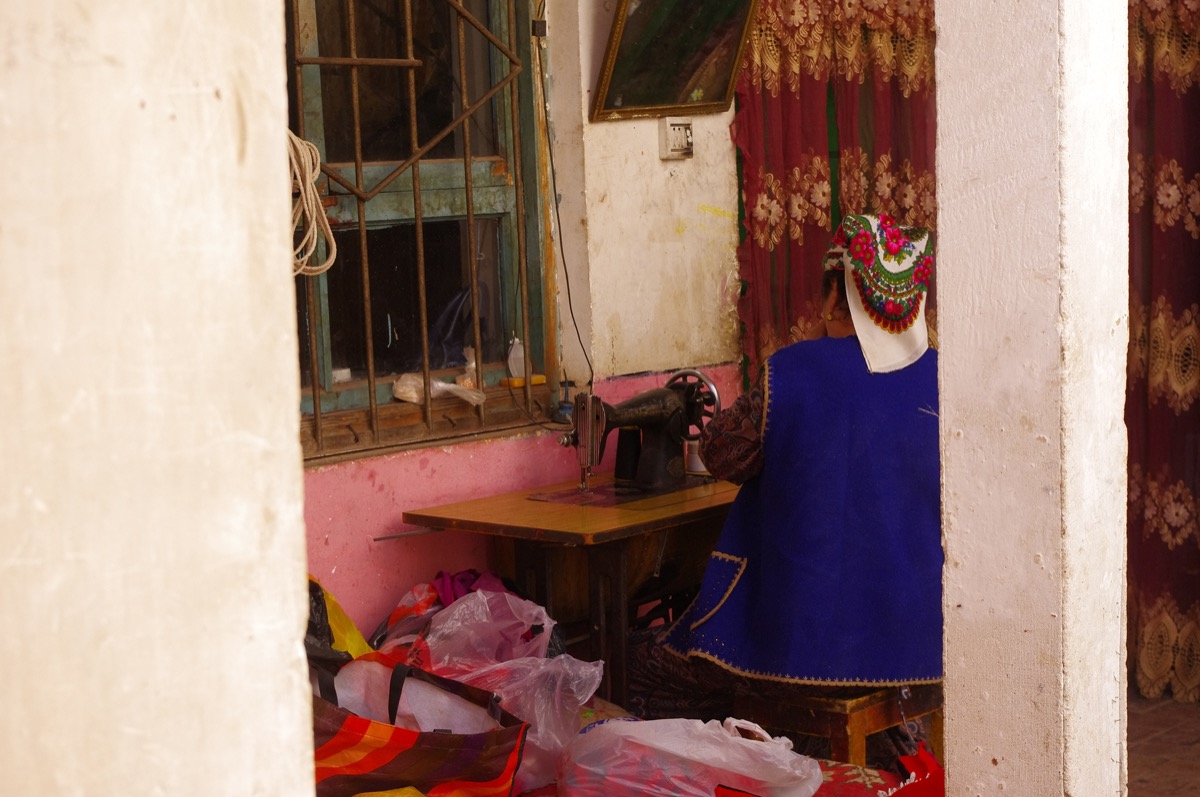 Kashgar old town” />
How it fits your route
Most travelers pick up the permit in Kashgar and then head south on the G314, the Karakoram Highway self-drive corridor, climbing past Opal, through the gorge at Baisha Lake, up to Karakul Lake at about 3,600 m, and on to Tashkurgan at roughly 3,100 m. The whole Kashgar–Tashkurgan run is about 290 km and takes 4–5 hours with checks. Without the paper, none of it happens.
Plan the permit into day one of your southern loop, sleep in Kashgar old town (the gate in the photo above is the heart of it), and collect the document before you fuel up and roll out. A calm morning of paperwork buys you two unforgettable days on the roof of the world.
FAQ
Do I need a border pass for every part of Xinjiang? No. The vast majority of the region — Urumqi, Turpan, the Ili grasslands, Sayram Lake, even Kanas — does not require one. The permit is only for designated border-defense counties, chiefly Tashkurgan on the Pamir.
How much does the 边防证 cost? Usually nothing. Issuing the border pass is free. Your only real cost is the time to apply, typically a same-day or next-day process in Kashgar.
Can I get it on the same day I want to drive? Sometimes, but I would not count on it. Apply the day you arrive in Kashgar. Offices often process in the morning for next-day collection, and a delay eats into your Pamir driving window.
Does the permit let me cross into Pakistan? No. It only authorizes presence in the Chinese border zone. Crossing at Khunjerab requires a Pakistan visa, vehicle documents, and separate arrangements.
Is the border pass valid for the Altai region too? Some frontier areas of the Altai near the Kazakhstan and Mongolia borders have required permits at times, but the rules there are less stable than for the Pamir. Always confirm locally before driving north.
What happens if I reach a checkpoint without it? You will be turned back. There is no on-the-spot fine that substitutes for the document; you simply cannot proceed into the border county.
Final word
The 边防证 sounds like a chore, but in practice it is a small, free formality that unlocks the Pamir — one of the greatest drives on the planet. Handle it early in Kashgar and the rest of the journey is pure road.
Written by Karl Huang, a Xinjiang-based travel writer. Border-zone rules and the list of open counties change frequently — confirm the current permit requirements with the Kashgar PSB or your hotel before you travel.